How Age Verification Technology Actually Confirms a Player Is 18 or Older

Age verification at a licensed gambling platform is a short sequence of checks. A document or database identity match, sometimes a biometric or liveness step, and a separate self-exclusion registry check all run before a new account can deposit or play. A typed birthdate with no verification behind it does not satisfy this requirement under current UK regulatory expectations. This article breaks down the three layers that do the actual work. Those layers are identity documents, biometric estimation, and database cross-checks. Each one has specific limitations that matter for understanding how the system behaves in practice.
Why “I Confirm I Am 18” Was Never Enough
The checkbox asking you to confirm your age has always been a statement of intent. Anyone can tick a box. Anyone can type a different birth year into a form field. The system that relies on self-declaration is essentially asking the person with the strongest incentive to lie whether they are telling the truth.
Regulators have caught up to this basic flaw. Under current UK Gambling Commission expectations, self-declaration of age alone is not considered sufficient. That includes a checkbox or typed birthdate with no verification against external data. The cost of getting it wrong is borne by the operator, the regulator, and potentially the minor. The person clicking “yes” does not bear that cost.
What replaced the checkbox is a verification sequence that pulls from sources outside the user’s control. The verification prompt asks for a document, a photo, and a database match. The difference between those two questions is the whole system.
Layer One: The Document and Identity Check
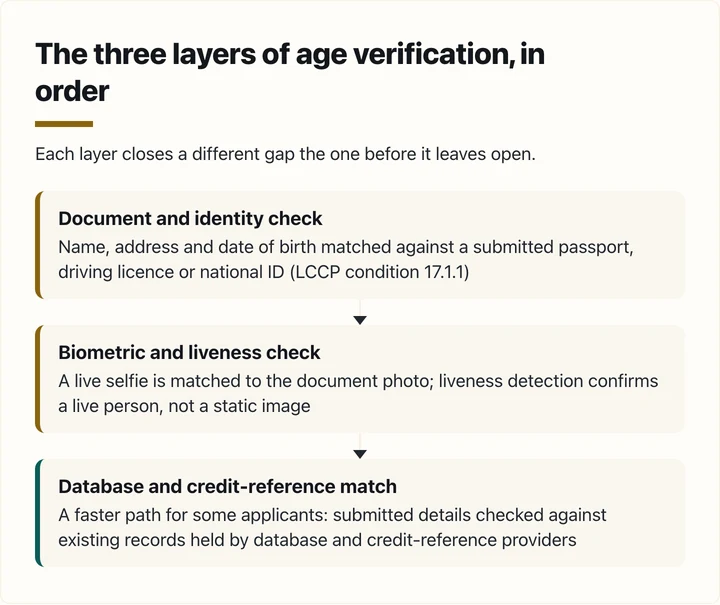
The first layer is the one most people picture when they hear the phrase “age verification.” A player submits an identity document and it gets checked. Under UK Gambling Commission LCCP condition 17.1.1, operators must verify a customer’s identity and confirm they are 18 or older before that customer can deposit, place a bet, or access gambling products. This happens at account registration, before any deposit or play is permitted.
The minimum data points operators must confirm are name, address, and date of birth. These are matched against the submitted document. That document could be a passport, driving licence, or national ID card. The document itself is examined for authenticity. Does the format match what the issuing authority actually produces? Do the security features hold up under inspection? Is it expired or reported lost or stolen?
What makes this layer meaningful is the external reference point. The operator is comparing the user’s claimed date of birth against a document issued by a third party with no stake in the gambling account being opened.
Document checks are not instantaneous in every case. Some verifications complete in seconds when the document scans cleanly and the data matches. Others route to manual review when something doesn’t line up. The user experience varies, but the underlying principle is consistent. The document is the anchor, and everything else hangs off it.
Layer Two: Biometric and Liveness Checks
A document alone has a weakness. It can be borrowed, stolen, or held up to a camera by someone who doesn’t match the picture. Layer two exists to close that gap.
Standard digital onboarding combines document verification with biometric face matching. The user submits a document and then takes a live selfie or short video. Software compares the facial geometry in the selfie against the photo on the document. If the faces don’t match, the verification fails regardless of how legitimate the document itself might be.
Some flows add a liveness detection step on top of the face match. It exists to confirm a live person is present, not a static image or recording. Without it, someone could hold a printed picture of the document holder up to the camera and potentially pass the face match. Liveness checks confirm that the person presenting the document is physically there in real time.
The layering matters here. Document verification establishes that the ID is real. Face matching establishes that the person presenting it is the person on the ID. Liveness detection establishes that the person is physically present. Each layer addresses a different failure mode. Removing any one of them reopens the hole it was designed to close.
What Facial Age Estimation Is and Isn’t
A separate technology sometimes gets confused with the verification layers above. It is called facial age estimation. Providers such as Yoti offer software that analyses a face image and estimates an age range. The word “estimate” is doing precise work here.
Facial age estimation does not identify the individual. It does not match the face against a database of known identities. It looks at a face image and returns a statistical guess about how old that person probably is. That guess is based on patterns learned from large datasets of faces with known ages.
Age estimation asks how old a person looks. Identity verification asks who a person is and whether their claimed identity is real. A system that estimates a person’s approximate age is a different mechanism from a system that confirms they are who they say they are.
The practical use case for age estimation is different too. It can act as a friction-reducing pre-check. It flags someone who is clearly well over the relevant threshold so they can skip heavier verification steps. It can also serve as a gate for lower-risk interactions. It is not a substitute for document-based identity verification when the requirement is to confirm a specific person’s age against an authoritative source. An estimate is a probability.
Layer Three: Database and Credit-Reference Matching
Not every verification flow requires a document upload. The third layer uses a faster path. It matches the submitted name, address, and date of birth against existing records held by database and credit-reference providers.
These services aggregate data from multiple sources to confirm whether a submitted identity corresponds to a real person at a real address. If the records line up, the operator gets confirmation that the identity is genuine without the user having to photograph a document.
Database checks are faster and less intrusive. There is no document scan, no selfie, and no waiting for manual review. They depend on the user having a sufficient data footprint. A young person with limited credit history or someone who has recently moved may not match cleanly against the available records. In those cases, the flow typically falls back to document verification.
Operators often use these layers in combination. A database match might handle the majority of applicants quickly. Document checks are reserved for cases where the data doesn’t line up. The user experience is smoother overall, but the standard being confirmed remains the same. That standard is name, address, and date of birth against an external source.

The Separate System: Self-Exclusion Registries
Age verification is often discussed alongside self-exclusion. They are separate mechanisms, and conflating them obscures how each actually works.
Self-exclusion registries let a person block themselves from gambling accounts. The UK model is GAMSTOP. When someone registers with GAMSTOP, they are added to a list that licensed operators are expected to check when new accounts are opened. The purpose is to prevent a person who has voluntarily excluded themselves from simply opening a new account elsewhere and continuing to gamble.
The distinction from age verification is fundamental. Age verification asks whether this person is old enough to gamble. Self-exclusion checks ask whether this person has chosen not to be allowed to gamble. Age verification confirms legal capacity to gamble. Self-exclusion protects individuals who have decided that gambling should not be available to them. GAMSTOP does not perform age verification. Age verification does not check self-exclusion status. They are parallel systems that serve different protective functions.
For a player who has self-excluded, the registry check is what stops them from re-entering through a different operator. For a minor attempting to open an account, the age-verification layers are what stop them before they can deposit. Both mechanisms protect the player. They protect against different risks, and they operate through different data sources.
When Verification Happens, Not Just Whether
The timing of verification matters as much as the fact that it happens. Condition 17.1.1 requires operators to verify a customer’s identity and confirm they are old enough to gamble before that customer can deposit, place a bet, or access gambling products.
The word “before” is doing regulatory work. There is no grace window during which a new account can deposit and play while verification catches up. The sequence is verify first, then allow access to gambling products. An operator that lets a customer deposit before completing verification is in breach of the condition. This applies regardless of whether that customer turns out to be an adult.
This timing requirement closes a loophole that would otherwise allow a minor to fund an account and gamble while verification checks are still pending. The current rule closes that window entirely. No verification means no deposit and no play.

Where the System Still Has Gaps
None of the layers described above is foolproof. Layered verification raises the bar substantially while leaving specific gaps open.
Borrowed documents remain a vulnerability. If an adult willingly hands their passport to a minor who resembles them, the document check will pass. The face match may pass. The liveness check will confirm a live person is present, because a live person is present. The system verifies that the person matches the document. It does not verify that the person is legally entitled to use it.
Geolocation and VPN workarounds create another gap. Verification requirements are tied to licensing jurisdictions. A player who routes their connection through a different country may encounter a different verification standard or none at all. The technology verifies identity. It does not necessarily verify the physical location of the person behind the screen.
The largest gap is the unlicensed market. Operators outside regulated jurisdictions have no equivalent requirement to verify age or identity before accepting deposits. A minor blocked by a licensed operator’s verification layers can, in principle, find an unlicensed site that asks for nothing more than an email address and a ticked checkbox. Regulation protects players who stay within regulated markets. It does not reach those who leave them.
None of this is an argument against verification. Layered systems meaningfully reduce the pathways available to minors and to people who have self-excluded. They don’t eliminate every possible route. Any claim that they do should be treated with skepticism.
What This Means If You’re Evaluating a Platform
If you are assessing how seriously a gambling platform takes player protection, verification quality is one visible signal among several. The presence of document checks, biometric matching, and database cross-checks before a first deposit indicates an operator that treats regulatory requirements as a floor. The floor is the minimum standard set by the licence condition. Operators that go beyond that minimum run additional checks and build verification into the registration flow itself.
A platform that asks only for a birthdate field and a checkbox is telling you something about its approach to compliance. A platform that runs a proper verification sequence before allowing play is telling you something different. The difference is observable without any special access. You can see it in the registration flow itself.
Verification is not the only signal worth watching. Self-exclusion tools, meaning how easily a player can set deposit limits or exclude themselves, form another layer of protection worth examining. The mechanisms that empower players to set deposit limits and cool-off periods are a separate system from age verification. They reflect the same underlying attitude toward player welfare.
Another visible signal is how the platform detects problematic play patterns. The AI systems casinos use to spot signs of problem gambling behavior operate after the account is open. They watch for behavioural markers. Together, these systems form a protective stack. Verification happens at the door. Self-exclusion tools are available throughout. Behavioural monitoring runs during play.
No single signal tells you everything about an operator’s commitment to player protection. A genuine verification sequence before a first deposit is a concrete, observable indicator. It shows that the platform treats its regulatory obligations as operational priorities.
FAQ
Is a birthdate field enough to verify a player’s age? No. A typed birthdate with no verification against external data is self-declaration, which is not considered sufficient under current UK regulatory expectations. Operators must confirm name, address, and date of birth against an external source such as an identity document or database records.
What documents can be used for age verification? Standard identity documents include passports, driving licences, and national ID cards. The document is checked for authenticity, and the name, address, and date of birth on it are matched against the details the user submitted during registration.
How does facial age estimation differ from facial recognition? Facial age estimation analyses a face image to estimate an age range. It does not identify the individual or match them against a database of faces. Facial recognition, by contrast, identifies who a person is. Age estimation is a statistical estimate.
Does GAMSTOP verify a player’s age? No. GAMSTOP is a self-exclusion registry that lets a person block themselves from gambling accounts. It is a separate mechanism from age and identity verification. Licensed operators check new applicants against the registry to prevent self-excluded individuals from opening new accounts, but GAMSTOP itself does not perform age verification.
When must age verification happen during account registration? Under the relevant UK Gambling Commission licence condition, operators must verify a customer’s identity and confirm they are old enough to gamble before that customer can deposit, place a bet, or access gambling products. Verification is required at account registration.